https://www.teachingenglish.org.uk/article/theories-reading
TRADITIONAL VIEW
DOLE (1991): readers acquire a set of hierarchy ordered sub-skills that build toward comprehension ability
NUNAN (1991): (BOTTOM-UP APPROACH) reading is a matter os decoding graphemes and linking them to the appropriate phonemes to make sense
MCCARTHY (1999): (OUTSIDE-IN APPROACH) meaning exists in the printed page and needs interpreting by the reader
Criticised as being insufficient due to the key focus only being on lexis and text structure.
COGNITIVE VIEW
GOODMAN (1967): (TOP-DOWN APPROACH) reading is a psycholinguistic guessing game and readers make hypotheses which the reject or confirm and the process repeats
RUMELHART (1977): (SCHEMA THEORY) if our schemata are incomplete and do not provide an understanding of the data presented to us then we have problems processing the text
Emphasis is on interaction and construction of concepts.
METACOGNITIVE VIEW
KLEIN (1991): readers utilise strategies:
*identify purpose of text
*identify form/type
*identify general character features of form
*projecting author's purpose
*scanning or reading in detail
*making continuous predictions on what's to come
Thinking about what you're doing whilst reading.
Wednesday, 31 May 2017

Tuesday, 30 May 2017
''THE LOST COCKNEY VOICE'':
http://www.bbc.co.uk/programmes/p051fhqs
*''Queen's Cockney'' = half Cockney and half Queen's English (current day example: Dot/June Brown from East Enders). Acquired around war time when the Queen's English accent was broadcasted on the radio and those listening would adopt aspects of it.
*Prejudices displayed towards Cockney's. Parents told their children ''you won't get a job if you don't speak properly''. Connotations of Cockney were ''commoners'' that were ''thick'' and of ''lower social class''.
*Cockney's used to live in a close-knit community until post-war when they started to spread out and Estuary English was produced.
*Younger generations were no longer influenced by the radio like their parents and grandparents as cinema became the key force, bringing in American variations of language.
*In the 90s, Estuary English became more fashionable and even those in power used it as a tactic to appear more approachable - Tony Blair.
*June Brown - aware of her ability to pick up and drop the Queen's Cockney accent depending on her location and who she was with.
*Although Cockney is a dying voice, due to the housing prices in London meaning young people can't afford to live there, the new equivalent today is Multicultural London English (MLE) and it also suffers the negative connotations of Cockney.
https://www.youtube.com/watch?v=0KdVoSS_2PM
*The One Show film exploring MLE and where it comes from. Linguists have found influences from all over, including Greece and Africa but it still maintains aspects of Cockney from which it developed. EG: th fronting (the use of the fricative sound f in replacement of the voiceless dental fricative th).
*The shift has occurred over one generation and therefore is continuing to grow - MLE is a dialect as well as an accent as its users create new slang and use it depending on how trendy or popular it is. This indicates that its growth is not over and could never be.
Thursday, 25 May 2017
FEEDBACK/KEY TARGETS:
DIALECT LEVELLING:
http://erinslanguageblog.blogspot.co.uk/2017/05/time-to-say-ta-ra-to-ar-ere-accents.html
*state audience
*caption image (make use of text conventions)
*ending should come back to argument - should we speak more similarly?
*good voice/style
*needs to examine pros and cons of argument with more AO2 detail
*link more to source material
COMPARISON OF DAILY MAIL AND THE GUARDIAN:
*reference to diachronic language change in intro
*be more objective
*analyse, don't describe
*analyse techniques in Humphrys quote
*keep to academic register
*needs more close terminological analysis of meanings and representations
PRESCRIPTIVISM VS DESCRIPTIVISM:
*'prescriptivism vs descriptivism' needs adapting
*continue the extended metaphor in the title
*prescriptivism is too broad, modify it to 'linguistic prescriptivism'
*work on guiding and positioning the reader
*needs more support for David Crystal's argument throughout for increased cohesion
*more AO2
*focuses are cohesion and guiding reader
LANGUAGE AND GENDER:
*needs title - artificial sexism and new/old ideas about language or teaching people how they should talk
*use conventions -picture of robot and caption about AIs learning stereotypes
*more of a hook or reason for writing - Baxter's theory applied to May?
*use synonyms like hypothesis to avoid repetition of 'theory'
*more detail about how theories have built on Lakoff's deficit, despite it being problematic
*more on the idea of teaching the value of women's language so apologising for linguistic choices is no longer necessary
*more theory like Cameron
Friday, 5 May 2017
CLA QUESTIONS:
SPOKEN LANGUAGE
1. What is phonemic expansion and contraction? Explain why this happens.
Occurs during the babbling stage, the number of different phonemes used increases (expansion). However later on at 9 to 10 months the child discards the phonemes (contraction) that aren't part of their native vernacular as they won't need them to communicate. Studies on babies of varying nationalities support this as they make different babbling sounds.
2. How is turn-taking encouraged in early speech development? Why is it important?
Games are often used to teach the 'rules' of turn-taking, such as passing a ball between each other. Children are also told it's 'Mummy's turn' or 'your turn'. Imitation is also key in turn-taking as it signifies anticipation for a turn as well as how to respond.
3. What is a phoneme and what is a grapheme?
A phoneme is the smallest unit of distinct sound from a word and words are made up of multiple phonemes. Whereas a grapheme is the smallest unit of a word in a writing system, like a certain letter or group of letters.
4. Which phonemes develop later than others? Whose research (‘Fis’ phenomenon) suggests it is articulation rather than not knowing the difference?
Consonants at the ends of words tend to be the last to be fully developed - this is seen in the 'Fis' phenomenon as the child was unable to produce the blended phoneme 'sh'. However this also demonstrates that the child can comprehend the correct phoneme to use before they possess the motor ability to produce the sound.
5. What is a protoword?
Protowords are words (typically cv patterns) such as 'gaga' and 'baba' that mimic the real word the child is attempting to say. For example: Deb Roy's son in his transition to using the word water started saying 'gaga' then 'wawa' - the protoword.
6. What is a holophrase?
A holophrase is the first stage of meaningful speech in the prelinguistic stage, where one word is used to express a whole concept/idea (holophrasis). Eg: A child will say 'up' when they want picking up or 'food' when they are hungry.
7. What are the four categories of first words according to Katherine Nelson (1973)?
Naming things - ball, dog, cat, pen
Actions - give, put, up
Social - no, hi, bye-bye
Modifiers - nice, more, that, this
8. What is positive reinforcement?
Positive reinforcement is encouraging a behaviour by giving a reward such as praise, a smile or a physical treat.
9. What is negative reinforcement?
Negative reinforcement is the act of taking away a negative stimulus as a reward for executing a desirable linguistic behaviour.
10. Explain the following stages of children’s linguistic development according to Jean Aitchison:
a. Labelling - linking words to objects and understanding that things can be given names
b. Packaging - exploring where these labels are applicable and stretching these names = over/underextension occurs until confident in meaning
c. Network-building - understanding similarities and differences in words and identifying differences
11. Explain the following stages of children’s linguistic development according to Piaget:
a. Sensorimotor - (Birth - 2 YO) Child is learning about the world through their movements. Object permanence and other ideas are learnt through assimilation and accommodation.
b. Pre-operational -(2 - 7 YO) Use words and images to represent objects/ideas, linking symbols to concepts. Very egocentric and think about things in concrete terms although their language is improving.
c. Concrete operational - (7 - 11 YO) Gain logical thinking processes, understanding conservation and applying these reasoning skills.
d. Formal operational - (12 YO +) Abstract thinking applied to theoretical problems and concepts, more ethical and social debates with reasoning.
12. What is Mean Length Utterance (MLU) and what can it tell us about a child’s language proficiency?
The mean length of utterance is a measure of the number of morphemes (the smallest unit of a word with meaning) in an utterance (an approximate sentence of speech). We assume that the higher the MLU, so the more morphemes per utterance, the more complex the speaking ability of the child.
13. Define the following stages in terms of a child’s grammatical development:
a. One word/holophrastic - One word is used to convey an idea, like 'up' signifies that the child wants to be picked up, 'food' signifies that the child is hungry, etc..
b. Two-word - Mini-sentences with simple semantic relations, slightly more detail than holophrastic stage.
c. Telegraphic - Sentences are not yet fully functional (like a telegram, the sentence includes all the information required for sense to be made of it).
d. Post-telegraphic - Sense of grammar emerges and this is applied to create more complex sentences.
1. What is phonemic expansion and contraction? Explain why this happens.
Occurs during the babbling stage, the number of different phonemes used increases (expansion). However later on at 9 to 10 months the child discards the phonemes (contraction) that aren't part of their native vernacular as they won't need them to communicate. Studies on babies of varying nationalities support this as they make different babbling sounds.
2. How is turn-taking encouraged in early speech development? Why is it important?
Games are often used to teach the 'rules' of turn-taking, such as passing a ball between each other. Children are also told it's 'Mummy's turn' or 'your turn'. Imitation is also key in turn-taking as it signifies anticipation for a turn as well as how to respond.
3. What is a phoneme and what is a grapheme?
A phoneme is the smallest unit of distinct sound from a word and words are made up of multiple phonemes. Whereas a grapheme is the smallest unit of a word in a writing system, like a certain letter or group of letters.
4. Which phonemes develop later than others? Whose research (‘Fis’ phenomenon) suggests it is articulation rather than not knowing the difference?
Consonants at the ends of words tend to be the last to be fully developed - this is seen in the 'Fis' phenomenon as the child was unable to produce the blended phoneme 'sh'. However this also demonstrates that the child can comprehend the correct phoneme to use before they possess the motor ability to produce the sound.
5. What is a protoword?
Protowords are words (typically cv patterns) such as 'gaga' and 'baba' that mimic the real word the child is attempting to say. For example: Deb Roy's son in his transition to using the word water started saying 'gaga' then 'wawa' - the protoword.
6. What is a holophrase?
A holophrase is the first stage of meaningful speech in the prelinguistic stage, where one word is used to express a whole concept/idea (holophrasis). Eg: A child will say 'up' when they want picking up or 'food' when they are hungry.
7. What are the four categories of first words according to Katherine Nelson (1973)?
Naming things - ball, dog, cat, pen
Actions - give, put, up
Social - no, hi, bye-bye
Modifiers - nice, more, that, this
8. What is positive reinforcement?
Positive reinforcement is encouraging a behaviour by giving a reward such as praise, a smile or a physical treat.
9. What is negative reinforcement?
Negative reinforcement is the act of taking away a negative stimulus as a reward for executing a desirable linguistic behaviour.
10. Explain the following stages of children’s linguistic development according to Jean Aitchison:
a. Labelling - linking words to objects and understanding that things can be given names
b. Packaging - exploring where these labels are applicable and stretching these names = over/underextension occurs until confident in meaning
c. Network-building - understanding similarities and differences in words and identifying differences
11. Explain the following stages of children’s linguistic development according to Piaget:
a. Sensorimotor - (Birth - 2 YO) Child is learning about the world through their movements. Object permanence and other ideas are learnt through assimilation and accommodation.
b. Pre-operational -(2 - 7 YO) Use words and images to represent objects/ideas, linking symbols to concepts. Very egocentric and think about things in concrete terms although their language is improving.
c. Concrete operational - (7 - 11 YO) Gain logical thinking processes, understanding conservation and applying these reasoning skills.
d. Formal operational - (12 YO +) Abstract thinking applied to theoretical problems and concepts, more ethical and social debates with reasoning.
12. What is Mean Length Utterance (MLU) and what can it tell us about a child’s language proficiency?
The mean length of utterance is a measure of the number of morphemes (the smallest unit of a word with meaning) in an utterance (an approximate sentence of speech). We assume that the higher the MLU, so the more morphemes per utterance, the more complex the speaking ability of the child.
13. Define the following stages in terms of a child’s grammatical development:
a. One word/holophrastic - One word is used to convey an idea, like 'up' signifies that the child wants to be picked up, 'food' signifies that the child is hungry, etc..
b. Two-word - Mini-sentences with simple semantic relations, slightly more detail than holophrastic stage.
c. Telegraphic - Sentences are not yet fully functional (like a telegram, the sentence includes all the information required for sense to be made of it).
d. Post-telegraphic - Sense of grammar emerges and this is applied to create more complex sentences.
14. What three stages of negative formations did Ursula Bellugi discover in young children?
STAGE 1 - 'No' put at start or end of utterance - 'no wear coat'
STAGE 2 - 'No' placed in the middle and next to a verb - 'I no like it'
STAGE 3 - Use 'don't' or 'can't' - 'I don't want to...'
(STAGE 4 - Use do not or can not correctly and precisely - 'I do not think...')
15. What does LAD stand for? Which theorist suggested we have a LAD? What is a LAD?
Chomsky's Language Acquisition Device / Universal Grammar is the idea that children have an innate sense of grammar and syntax which they apply when learning language. For example they instinctively know how to combine a verb and noun to create a coherent sentence and this is true for children of all languages.
16. What is a virtuous error? Give examples.
The mistakes a child makes when developing their language abilities, typicallt over/under applying certain grammar rules such as adding or forgetting a suffix or getting syntax slightly incorrect. Eg: I runned instead of I ran, he swimmed instead of he was swimming or he swam.
17. What are overextension and underextension? How do they contradict Skinner’s ideas?
Overextension - chid uses a single word to describe many different things:
BY ANALOGY - inferring a similarity between objects, like referring to anything round as a ball
BY CATEGORY - using one word to label all things in that category, such as calling all animals horse
18. What is Universal Grammar?
(LAD) Children have an innate genetic component to their language understanding and this device aids them in communication.
19. How are Bruner and Vygotsky's theories similar and different? Give examples and use terminology.
Both Vygotsky and Bruner value the importance of socialisation on language development. Bruner highlights the importance of CDS (child-directed speech) and believes that it's a key aid in communication for children - also referred to as scaffolding which links to Vygotsky. The ZPD is based on the principle that children have different zones to their knowledge and to reach their full potential assistance from adults is required and this is called scaffolding. Assistance can be anything from general encouragement or specific demonstration/instruction. Due to this theories, both Bruner and Vygotsky fall on the nurture side of the CLA debate.
However Bruner's theory has a slight biological link in its stage theory. Bruner believes that as children grow older their intelligent minds create different coding systems and this is the reason for certain behaviours expressing themselves at certain ages - such as a baby making a rattle shaking action w/out the rattle as in the enactive representation stage any memories are action-based. Vygotsky's theory is purely focused on socialisation and cooperative learning. As the child gets older the actions that others involve them in mature and so their development progresses.
20. How are Halliday and Dore’s categories similar and different?
Both theorists agree that child language focuses on needs and requesting actions, such as asking for a parent to do something for them however their reasons why differ. Halliday believes that these demands are used to satisfy a particular need but also to control and influence the behaviour of others. Whereas Dore simply thinks that these are demands without any motive to control or be dominant. Halliday's categories focus more on wider explanations for language such heuristic - used to widen understanding of their surrounding environment. Dore on the other hand views child speech as more basic and believes techniques are used to gain attention (calling) and to greet others rather than aid their cognitive development.
21. What is egocentric speech?
Repetitive phrases that a child speaks when alone as a method of practising what they've learnt - eg: a running commentary on what they're playing with their toys.
22. Child-led discourse?
*couldn't find anything online so I guessed*
Child-led discourse is the name given to conversation initiated by the child. They may use items in their surroundings (local topics) to base conversation on and use interrogatives to direct conversation.
23. What are some useful features of CDS to discuss in an essay and why?
GRAMMAR - simpler constructions with fewer verbs, modifiers and adjectives, links to Deb Roy's findings that just before a word is added to a a child's vocabulary, those around them use the word in basic syntactic structures
PRAGMATICS - support, signified linguistically through expansions and re-castings but also through body language. Highlights importance of socialisation and support from others to develop language rather than simply stating lang comes from a biological device. Also evidence for Vygotsky's scaffolding.
LEXIS AND SEMANTICS - increased used of dynamic verbs and concrete nouns, supports Nelson's theory of the word categories first established.
24. What does recast/reformulation mean?
Reformulation is a type of modelling in which an adult repeats back an utterance said by the child however they correct any errors. Eg: 'mummy me want the ball please', 'you mean i want the ball please'. Positively reinforces the correct uses by repeating them back and also corrects non-standard uses.
25. What does LASS stand for and whose theory is it?
Bruner's LASS was created in opposition to Chomsky's LAD - parents support/scaffold linguistic development by frequently asking the child questions and actively using their surroundings to trigger conversation (eg: paralinguistic traits like pointing). Emphasises socialisation as opposed to biology and nativism like Chomsky.
26. Define the following theories and say who the theorist(s) are for each:
a. Nativist - Chomsky, language is innate and each child has a natural sense for syntax and grammar for their specific language.
b. Behaviourist - Skinner, applies behaviourist laws of operant conditioning and reinforcement to language development.
c. Social interactionist - Vygotsky/Bruner, interaction and social scaffolding aids communication.
d. Cognitive - Piaget, language development is parallel with cognitive development and is gained as a result of children learning logic and reasoning.
e. Critical period - Lenneberg, ends around puberty when the brain decreases in plasticity, if a language isn't learnt by this point the child will never be fluent.
Tuesday, 2 May 2017
TIME TO SAY TA-RA TO AR' 'ERE ACCENTS?
*With artificial intelligence and voice recognition technology slowly being integrated into our daily lives, the dialects of Britain may be facing an accent-identity crisis*
''SIRI, tell ma, where's you to?''
''Sorry, I did not get that''
''Tell ar' ma where's she to?''
''I could not find an 'armour' in your contacts''
''Bloody 'ell, TEXT MUM SAYING WHERE ARE YOU?''
An easily recognisable struggle for any thick-accented folk out there; voice recognition technology, such as Siri and Amazon's Alexa, simply have no clue what on Earth you're on about. But will the many accents of Britain disappear before the problem does?
Making judgements and sweeping generalisations about you based on your pronunciation of the word 'scone' is something we are likely to have all done, nevertheless your voice is also unique to you and is packed with quirks that your family and friends adore. It forms part of your identity. Your linguistic fingerprint reflects where you've been and who you surround yourself with. A ComRes poll as part of an ITV Tonight investigation asked 4,000 Brits what they thought the most intelligent, friendly and trust-worthy sounding accents were and the general consensus was as follows:

RP was rated as the most intelligent sounding, Devon was labelled as having the friendliest accent and both RP and Devon were top for trust-worthiness. However across the board accents like Brummy and Scouse were generally rated as unintelligent and unfriendly, signifying these prejudices are very real and their speakers are likely to feel the brunt of it too during interviews and first impressions.
So, could accent levelling be an unconscious response to these judgements and people no longer want to be held back by their differing diphthongs?
Another explanation for this shift in dialect variation is the tolerance of technology. As mentioned previously, any Geordies or Bristolians are likely to relate to the language barrier you have between yourself and your phone - which almost always results in a poor attempt at an impression of the Queen just to ask where the closest Nandos is. But as Artificial Intelligence develops, surely it will become more tolerant of thick accents or we may have all succumbed to Received Pronunciation before this happens. John Oliver acknowledges this issue in his recent interview on the Tonight Show Starring Jimmy Fallon. The topic of conversation shifts to language barriers and whether he, as a Brit living in the States, has suffered any awkward miscommunications due to his accent. John Oliver is quick to mention automated machines and how they 'batter you into submission' to using a 'sedated John Wayne' style American accent and other audience members agree - so the UK isn't alone here.
Protesting for linguistic individuality, HSBC Bank are embracing our quirks and have recently introduced voice-recognition passwords, as opposed to a code or fingerprint, to maximise security. Their new biometric banking system obtains data on your voice, noting 50 physical and 50 behavioural characteristics which are unique to you. Allowing you access to personal information after speaking gibberish to your phone for approximately 15 seconds. If we converge further then it'll be interesting to see whether HSBC's biometric system also suffers.
*Unfinished, unsure on how to end/round up ideas*
''SIRI, tell ma, where's you to?''
''Sorry, I did not get that''
''Tell ar' ma where's she to?''
''I could not find an 'armour' in your contacts''
''Bloody 'ell, TEXT MUM SAYING WHERE ARE YOU?''
An easily recognisable struggle for any thick-accented folk out there; voice recognition technology, such as Siri and Amazon's Alexa, simply have no clue what on Earth you're on about. But will the many accents of Britain disappear before the problem does?
Making judgements and sweeping generalisations about you based on your pronunciation of the word 'scone' is something we are likely to have all done, nevertheless your voice is also unique to you and is packed with quirks that your family and friends adore. It forms part of your identity. Your linguistic fingerprint reflects where you've been and who you surround yourself with. A ComRes poll as part of an ITV Tonight investigation asked 4,000 Brits what they thought the most intelligent, friendly and trust-worthy sounding accents were and the general consensus was as follows:

RP was rated as the most intelligent sounding, Devon was labelled as having the friendliest accent and both RP and Devon were top for trust-worthiness. However across the board accents like Brummy and Scouse were generally rated as unintelligent and unfriendly, signifying these prejudices are very real and their speakers are likely to feel the brunt of it too during interviews and first impressions.
So, could accent levelling be an unconscious response to these judgements and people no longer want to be held back by their differing diphthongs?
Another explanation for this shift in dialect variation is the tolerance of technology. As mentioned previously, any Geordies or Bristolians are likely to relate to the language barrier you have between yourself and your phone - which almost always results in a poor attempt at an impression of the Queen just to ask where the closest Nandos is. But as Artificial Intelligence develops, surely it will become more tolerant of thick accents or we may have all succumbed to Received Pronunciation before this happens. John Oliver acknowledges this issue in his recent interview on the Tonight Show Starring Jimmy Fallon. The topic of conversation shifts to language barriers and whether he, as a Brit living in the States, has suffered any awkward miscommunications due to his accent. John Oliver is quick to mention automated machines and how they 'batter you into submission' to using a 'sedated John Wayne' style American accent and other audience members agree - so the UK isn't alone here.
Protesting for linguistic individuality, HSBC Bank are embracing our quirks and have recently introduced voice-recognition passwords, as opposed to a code or fingerprint, to maximise security. Their new biometric banking system obtains data on your voice, noting 50 physical and 50 behavioural characteristics which are unique to you. Allowing you access to personal information after speaking gibberish to your phone for approximately 15 seconds. If we converge further then it'll be interesting to see whether HSBC's biometric system also suffers.
*Unfinished, unsure on how to end/round up ideas*
Saturday, 22 April 2017
CLA - PHONOLOGICAL DEVELOPMENT:
PRELINGUISTIC FEATURES:
In the first year we see:
*Crying
*Cooing
*Babbling, rhythmic and melodic
*Phonemic expansion and contraction
*Repeated consonant-vowel patterns
AVERAGE AGES:
*AGE 2 1/2 - Can pronounce all vowels and 2/3 of consonants
First consonants mastered tend to be: b d m n h
*AGE 4 - Struggles with a few consonants but confident elsewhere
Difficulty tends to arise with pronunciation of consonants at the end of words rather than the beginning.
*AGE 6/7 - Confident use of all phonemes.
SIPLIFICATION MECHANISMS:
If the child repetitively struggles with pronunciation then they utilise a variety of techniques to overcome these difficulties and still communicate:
*DELETION - Omitting the final consonant of words - ca(t), bow(l)
*CONSONANT CLUSTER REDUCTIONS - Clusters of consonants are difficult to produce so they are reduced to smaller units - nake for snake, pider for spider
*DELETION OF UNSTRESSED SYLLABLES - Omitting the opening syllable of polysyllabic words - (ba)nana
*SUBSTITUTION - Substituting another phoneme/sound in to replace another - dere for there, pip for ship
*ADDITION - Extra vowel sound added to the end of the word to create a CV pattern as used in babbling - dog to doggie, pig to piggy
*REDUPLICATION - Repetition of the whole syllable in a word - choochoo
*ASSIMILATION - Changing only one consonant or vowel directly for another - gog for dog
INTONATION:
As the child matures and their linguistic abilities strengthen, they use varied intonation to express further meaning. The motor ability to vary intonation is gained at a young age however understanding of the connotations still develops all the way up to teen years.
* 'my car' vs 'MY car' ---> stress on 'MY' has implied meaning of not wanting to share and strong possession.
*CRUTTENDEN 1974 - Investigated the effect of intonation on children and adult predictions of a football score. Found the adults successfully predicted the winners based on the intonation stressed on the team name over the voice-over but the children (aged 7-11) were significantly less successful than the adults.
AITCHISON:
'It is unlikely that a new born baby or child under one year realise that the sounds that come out of people’s mouths ‘stand for’ things and actions’ - 1987
*Aitchison drew links between a child's semantic and lexical growth:
STAGE 1 / LABELLING - Linking words to objects and understanding that things can be given names.
STAGE 2 / PACKAGING - Exploring where these labels are applicable and stretching these names = over/underextension occurs until confident in meaning.
STAGE 3 / NETWORK BUILDING - Understanding similarities and differences in words and identifying opposites.
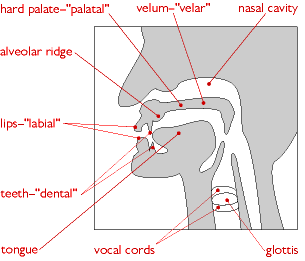
ARTICULATION:
*PLACE OF ARTICULATION = the place in the mouth the sound originates
BILABIAL - produced with the two lips
INTERDENTAL - tongues between teeth
ALVEOLAR - produced at alveolar ridge
ALVEIO-PALATAL - starts at alveolar ridge then straight to palate
PALATAL - produced at palate
VELAR - produced at velum/soft palate
GLOTTAL - produced at glottis, upper larynx
*MANNER of articulation = the way the sound is produced
PLOSIVE/STOP - total stoppage of airflow in mouth - voiceless: t, k, p voiced: b, d, g
FRICATIVE - partial use of vocal tract producing audible friction - voiced/voiceless: f, th
AFFRICATIVE - stopping airflow then partial release into a fricative - ch, j
NASAL - stopping airflow in the mouth but allowing it to continue in nasal cavity - n, m
LIQUID - give impression of water flowing - r, l
LATERAL - touching tongue to roof of mouth and letting air pass either side - l
APPROXIMANT - consonant produced without turbulence or blockage of airflow - l, y, w
In the first year we see:
*Crying
*Cooing
*Babbling, rhythmic and melodic
*Phonemic expansion and contraction
*Repeated consonant-vowel patterns
AVERAGE AGES:
*AGE 2 1/2 - Can pronounce all vowels and 2/3 of consonants
First consonants mastered tend to be: b d m n h
*AGE 4 - Struggles with a few consonants but confident elsewhere
Difficulty tends to arise with pronunciation of consonants at the end of words rather than the beginning.
*AGE 6/7 - Confident use of all phonemes.
SIPLIFICATION MECHANISMS:
If the child repetitively struggles with pronunciation then they utilise a variety of techniques to overcome these difficulties and still communicate:
*DELETION - Omitting the final consonant of words - ca(t), bow(l)
*CONSONANT CLUSTER REDUCTIONS - Clusters of consonants are difficult to produce so they are reduced to smaller units - nake for snake, pider for spider
*DELETION OF UNSTRESSED SYLLABLES - Omitting the opening syllable of polysyllabic words - (ba)nana
*SUBSTITUTION - Substituting another phoneme/sound in to replace another - dere for there, pip for ship
*ADDITION - Extra vowel sound added to the end of the word to create a CV pattern as used in babbling - dog to doggie, pig to piggy
*REDUPLICATION - Repetition of the whole syllable in a word - choochoo
*ASSIMILATION - Changing only one consonant or vowel directly for another - gog for dog
INTONATION:
As the child matures and their linguistic abilities strengthen, they use varied intonation to express further meaning. The motor ability to vary intonation is gained at a young age however understanding of the connotations still develops all the way up to teen years.
* 'my car' vs 'MY car' ---> stress on 'MY' has implied meaning of not wanting to share and strong possession.
*CRUTTENDEN 1974 - Investigated the effect of intonation on children and adult predictions of a football score. Found the adults successfully predicted the winners based on the intonation stressed on the team name over the voice-over but the children (aged 7-11) were significantly less successful than the adults.
AITCHISON:
'It is unlikely that a new born baby or child under one year realise that the sounds that come out of people’s mouths ‘stand for’ things and actions’ - 1987
*Aitchison drew links between a child's semantic and lexical growth:
STAGE 1 / LABELLING - Linking words to objects and understanding that things can be given names.
STAGE 2 / PACKAGING - Exploring where these labels are applicable and stretching these names = over/underextension occurs until confident in meaning.
STAGE 3 / NETWORK BUILDING - Understanding similarities and differences in words and identifying opposites.

ARTICULATION:
*PLACE OF ARTICULATION = the place in the mouth the sound originates
BILABIAL - produced with the two lips
INTERDENTAL - tongues between teeth
ALVEOLAR - produced at alveolar ridge
ALVEIO-PALATAL - starts at alveolar ridge then straight to palate
PALATAL - produced at palate
VELAR - produced at velum/soft palate
GLOTTAL - produced at glottis, upper larynx
*MANNER of articulation = the way the sound is produced
PLOSIVE/STOP - total stoppage of airflow in mouth - voiceless: t, k, p voiced: b, d, g
FRICATIVE - partial use of vocal tract producing audible friction - voiced/voiceless: f, th
AFFRICATIVE - stopping airflow then partial release into a fricative - ch, j
NASAL - stopping airflow in the mouth but allowing it to continue in nasal cavity - n, m
LIQUID - give impression of water flowing - r, l
LATERAL - touching tongue to roof of mouth and letting air pass either side - l
APPROXIMANT - consonant produced without turbulence or blockage of airflow - l, y, w
Friday, 21 April 2017
MORE CLA THEORISTS/RESEARCH:
BERKO AND BROWN: FIS PHONOMENON -
*Perception of phonemes comes before production
*1960 - Berko & Brown: child referred to toy fish as 'fis', when asked if the toy was his 'fis' he responded no but when asked if it was his 'fish', he'd respond yes.
*Shows that although he lacked the motor ability to create the phoneme 'sh', he was able to hear it and comprehend that 'sh' was the appropriate phoneme for fish.
*Example: https://www.youtube.com/watch?v=6tmlhQAlP5c
Eve describes her toy fish as a 'jep' but when the mother responds 'your jep?' she protests and begins to get frustrated as she is trying hard to pronounce 'fish' even though it is out of her capabilities at the moment. But when asked if it's her 'fish' she responds: 'yes, jep!' and sounds relieved that the mother got it right.
JEAN BERKO: WUG TEST -
* 1958 - Testing knowledge of grammar when applied to gibberish words - if children memorise all that they hear, without analysing the morphemes, how will they react when encountering words they've never heard before? It can't be on their grammar lists if they haven't heard it before.
*EG:

This is a Wug <'-'>
Now there's another one <'-'> <'-'>
There's 2 of them. There are 2 ........ (Child finishes sentence) WugS.
*Indicates that we remember more than just words and word combinations.
*Children must have a more complex understanding of grammar than initially thought - supports Chomsky's Universal Grammar rather than imitation as words had never been heard before.
*Wug test also used in other countries and has application to many languages.
NELSON: FIRST WORDS -
* http://the-language-cru.blogspot.co.uk/2013/05/katherine-nelson.html
*Against Piaget as she views CLA as a 'bridge between a child's social and cultural growth with their growing knowledge of the world'.
*1973 - Study of the first words of 18 children and classified the first 50 words a child learns:
NAMING THINGS - Ball, Dog, Car, Baby, Mummy, Daddy, Shoe
ACTIONS - Give, Put, Down, Stop, Sit
SOCIAL - Hi, No, Bye-Bye, Yes
MODIFIERS - Nice, More, This, Dirty
*The largest group of words (60%ish) were nouns for people, animals and objects, followed by demands/actions and then modifiers and social words.
*Local topics tend to make up the first set of words and Nelson found that objects that are small and handled by kids are the first spoken, unlike large objects like houses etc.
PATRICIA KUHL: STATISTICS -
*Why can't we preserve a language by speaking to adults? Agrees with the critical period that our ability to learn language is at a pinnacle up until age 7 where it gradually slopes off until puberty.
*Kuhl focuses on the 'first critical period in development' - where babies try to master the sounds used in their own language.
*Head turning task used: Baby on mother's lap and sounds played of different phonemes. Timing of head turning is measured to distinguish the sounds they recognise and acknowledge. Found that babies can distinguish between all sounds of all languages but adults are culture-bound listeners - this changes before they turn 1.
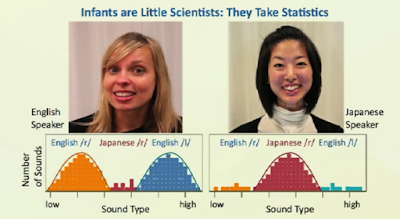 *During this period babies are taking statistics on how their parents, and the adults speaking their intended language around them, speak.
*EG: Statistics of English and Japanese are very different:
*These statistics change the brains of babies and thus shape them into culture-bound listening adults.
*Kuhl exposed American babies during this critical period to Mandarin (12 sessions in 1 month) and found that they had taken on board the statistics just as well as the native babies in Taiwan who had been listening for 10 months.
*They ran further tests in which babies were exposed to Mandarin through TV, just audio and through human interaction and found that only social interaction taught them the statistics. (Support for importance of socialisation in CLA).
DEB ROY: BIRTH OF A WORD -
*Cameras and microphones in every room set on continuous capture
*3 years recorded, 90,000 hours of video, 1240,000 hours of audio, 200 terabytes, over 7 million words transcribed - all to understand the social influence on language acquisition
*1 - 1.5 years old, son learned the pronunciation of water from gagagaga to gaga to guga to wada to wader to water ... however this wasn't linear as he between making progress would return back to gaga between steps.
*Why are certain words born first? Parent speech decreases in complexity just before a word is learnt and then slowly ascends back - caregivers are systematically and subconsciously restructuring their language to assist learning (scaffolding).
*Context: the word water is predominantly heard in the kitchen and thus that's where it is mainly spoken and 'bye' is mainly used at the door (highlights importance of context and environment).
BELLUGI: NEGATION -
*1966 - Proposed a stage theory in the formation of negatives.
*Believes that children find it hard to immediately form negatives correctly so they learn in stages:
STAGE 1 - 'No' put at start or end of utterance - 'no wear coat'
STAGE 2 - 'No' placed in the middle and next to a verb - 'I no like it'
STAGE 3 - Use 'don't' or 'can't' - 'I don't want to...'
STAGE 4 - Use do not or can not correctly and precisely - 'I do not think...'
PRONOUNS -
*Same sort of idea with pronoun development:
STAGE 1 - Uses own name (Third person) - 'Poppy play'
STAGE 2 - Acknowledges 'I' and 'Me' (First person) - 'Me eat food'
STAGE 3 - Correct form
*Perception of phonemes comes before production
*1960 - Berko & Brown: child referred to toy fish as 'fis', when asked if the toy was his 'fis' he responded no but when asked if it was his 'fish', he'd respond yes.
*Shows that although he lacked the motor ability to create the phoneme 'sh', he was able to hear it and comprehend that 'sh' was the appropriate phoneme for fish.
*Example: https://www.youtube.com/watch?v=6tmlhQAlP5c
Eve describes her toy fish as a 'jep' but when the mother responds 'your jep?' she protests and begins to get frustrated as she is trying hard to pronounce 'fish' even though it is out of her capabilities at the moment. But when asked if it's her 'fish' she responds: 'yes, jep!' and sounds relieved that the mother got it right.
JEAN BERKO: WUG TEST -
* 1958 - Testing knowledge of grammar when applied to gibberish words - if children memorise all that they hear, without analysing the morphemes, how will they react when encountering words they've never heard before? It can't be on their grammar lists if they haven't heard it before.
*EG:

This is a Wug <'-'>
Now there's another one <'-'> <'-'>
There's 2 of them. There are 2 ........ (Child finishes sentence) WugS.
*Indicates that we remember more than just words and word combinations.
*Children must have a more complex understanding of grammar than initially thought - supports Chomsky's Universal Grammar rather than imitation as words had never been heard before.
*Wug test also used in other countries and has application to many languages.
NELSON: FIRST WORDS -
* http://the-language-cru.blogspot.co.uk/2013/05/katherine-nelson.html
*Against Piaget as she views CLA as a 'bridge between a child's social and cultural growth with their growing knowledge of the world'.
*1973 - Study of the first words of 18 children and classified the first 50 words a child learns:
NAMING THINGS - Ball, Dog, Car, Baby, Mummy, Daddy, Shoe
ACTIONS - Give, Put, Down, Stop, Sit
SOCIAL - Hi, No, Bye-Bye, Yes
MODIFIERS - Nice, More, This, Dirty
*The largest group of words (60%ish) were nouns for people, animals and objects, followed by demands/actions and then modifiers and social words.
*Local topics tend to make up the first set of words and Nelson found that objects that are small and handled by kids are the first spoken, unlike large objects like houses etc.
PATRICIA KUHL: STATISTICS -
*Why can't we preserve a language by speaking to adults? Agrees with the critical period that our ability to learn language is at a pinnacle up until age 7 where it gradually slopes off until puberty.
*Kuhl focuses on the 'first critical period in development' - where babies try to master the sounds used in their own language.
*Head turning task used: Baby on mother's lap and sounds played of different phonemes. Timing of head turning is measured to distinguish the sounds they recognise and acknowledge. Found that babies can distinguish between all sounds of all languages but adults are culture-bound listeners - this changes before they turn 1.
 *During this period babies are taking statistics on how their parents, and the adults speaking their intended language around them, speak.
*EG: Statistics of English and Japanese are very different:
*These statistics change the brains of babies and thus shape them into culture-bound listening adults.
*Kuhl exposed American babies during this critical period to Mandarin (12 sessions in 1 month) and found that they had taken on board the statistics just as well as the native babies in Taiwan who had been listening for 10 months.
*They ran further tests in which babies were exposed to Mandarin through TV, just audio and through human interaction and found that only social interaction taught them the statistics. (Support for importance of socialisation in CLA).
DEB ROY: BIRTH OF A WORD -
*Cameras and microphones in every room set on continuous capture
*3 years recorded, 90,000 hours of video, 1240,000 hours of audio, 200 terabytes, over 7 million words transcribed - all to understand the social influence on language acquisition
*1 - 1.5 years old, son learned the pronunciation of water from gagagaga to gaga to guga to wada to wader to water ... however this wasn't linear as he between making progress would return back to gaga between steps.
*Why are certain words born first? Parent speech decreases in complexity just before a word is learnt and then slowly ascends back - caregivers are systematically and subconsciously restructuring their language to assist learning (scaffolding).
*Context: the word water is predominantly heard in the kitchen and thus that's where it is mainly spoken and 'bye' is mainly used at the door (highlights importance of context and environment).
BELLUGI: NEGATION -
*1966 - Proposed a stage theory in the formation of negatives.
*Believes that children find it hard to immediately form negatives correctly so they learn in stages:
STAGE 1 - 'No' put at start or end of utterance - 'no wear coat'
STAGE 2 - 'No' placed in the middle and next to a verb - 'I no like it'
STAGE 3 - Use 'don't' or 'can't' - 'I don't want to...'
STAGE 4 - Use do not or can not correctly and precisely - 'I do not think...'
PRONOUNS -
*Same sort of idea with pronoun development:
STAGE 1 - Uses own name (Third person) - 'Poppy play'
STAGE 2 - Acknowledges 'I' and 'Me' (First person) - 'Me eat food'
STAGE 3 - Correct form
Tuesday, 18 April 2017
OPINION ARTICLE - CATCH IT, BIN IT, KILL IT: PRESCRIPTIVISM VS DESCRIPTIVISM
(Not the best so just some ideas thrown together)
https://www.theguardian.com/commentisfree/video/2016/apr/20/grammar-snobs-are-patronising-pretentious-and-just-plain-wrong-video#comment-72877318
Do you suffer from chronic irritation at the sight of a misused apostrophe? Do you tense up when someone begins a sentence with 'and' or 'but'? Are you unable to stop your entire body twitching when someone writes defiantly instead of definitely, or pacifically instead of specifically? Then it sounds like you have a textbook case of prescriptivism - a linguistic syndrome, almost an epidemic. Prescriptivism is the name given to the belief that language shouldn't change and should only be used as originally intended. Prescriptivists hold the view that any non-standard uses of the English language are simply incorrect and quite frankly disgusting. If this all sounds familiar to you then don't be offended! You'll find fellow sufferers in the comment section of Guardian articles and deep in the abyss of Reddit. But where did the outbreak start? Language change and standardisation have been hot topics for linguists for centuries and evolution in technology, war and fashion have fuelled the discussion but the debate is far from settled.
Time for a brief run through history to gather a sense of the argument and where we stand: 1476, Caxton's printing press is released and the ignition to the language change argument is set ablaze. Previous spellings for words are simply cast out due to there either being a technical issue with printing certain spellings (hence the use of the long S in many shakespearian texts) or publishers take responsibility into their own hands and choose spellings which they rank as being most popular. This is followed by an onslaught of dictionaries and language guides from almost half the English speaking population as they each felt their dialect was superior and most efficient. And thus the prescriptivist attitude was born. People began to order Englishes into a hierarchy of most to least desirable to rid of certain traits and although today our language is fairly standard there are some areas of grammar causing dispute.
Prescriptivist attitudes are no mystery to linguists either. Jean Aitchison, a Professor of Language and Communication at the University of Oxford, developed a few theories to attempt to explain the views of prescriptivism and why we aren't all just accepting of language change and its inevitability.
1) Damp Spoon Syndrome - 'wrong or bad English' is a result of laziness and, like those who leave a damp spoon to soak in the sugar bowl, it sticks and people cannot be bothered to correct themselves.
2) Infectious Disease - linguistic diseases are spread between people with no control or preventative medicine. People catch 'poor language' and spread it amongst their peers with no say in the matter.
3) Crumbling Castle - our language was once a beautiful archaic castle sat upon a hill and should be frozen this way in time forever and preserved but language has never been at a pinnacle - so when would we save it?
But Aitchison however is a representative of the opposing team - the descriptivists.
Descriptivism is the antithesis of prescriptivism as the argument supports language change and accepts that it is necessary and useful. Descriptivists never judge language as 'incorrect' or 'mistake-ridden' but instead they comment on how 'non-standard' it is. The descriptivists are the optimists in the argument as they look back in history to appreciate how far we have come linguistically and theorise about the potential English has to expand even further. Well-known linguist David Crystal is quotes as saying ''the only languages that do not change are the dead ones'' and in my eyes this summarises the debate perfectly. If language was a person we would expect them to learn through experience and grow so why stop this process?
So the next time you catch your nose running at the sight of the latest internet coined slang term, consider the creativity that goes into language and don't take someone's voice away.
https://www.theguardian.com/commentisfree/video/2016/apr/20/grammar-snobs-are-patronising-pretentious-and-just-plain-wrong-video#comment-72877318
Do you suffer from chronic irritation at the sight of a misused apostrophe? Do you tense up when someone begins a sentence with 'and' or 'but'? Are you unable to stop your entire body twitching when someone writes defiantly instead of definitely, or pacifically instead of specifically? Then it sounds like you have a textbook case of prescriptivism - a linguistic syndrome, almost an epidemic. Prescriptivism is the name given to the belief that language shouldn't change and should only be used as originally intended. Prescriptivists hold the view that any non-standard uses of the English language are simply incorrect and quite frankly disgusting. If this all sounds familiar to you then don't be offended! You'll find fellow sufferers in the comment section of Guardian articles and deep in the abyss of Reddit. But where did the outbreak start? Language change and standardisation have been hot topics for linguists for centuries and evolution in technology, war and fashion have fuelled the discussion but the debate is far from settled.
Time for a brief run through history to gather a sense of the argument and where we stand: 1476, Caxton's printing press is released and the ignition to the language change argument is set ablaze. Previous spellings for words are simply cast out due to there either being a technical issue with printing certain spellings (hence the use of the long S in many shakespearian texts) or publishers take responsibility into their own hands and choose spellings which they rank as being most popular. This is followed by an onslaught of dictionaries and language guides from almost half the English speaking population as they each felt their dialect was superior and most efficient. And thus the prescriptivist attitude was born. People began to order Englishes into a hierarchy of most to least desirable to rid of certain traits and although today our language is fairly standard there are some areas of grammar causing dispute.
Prescriptivist attitudes are no mystery to linguists either. Jean Aitchison, a Professor of Language and Communication at the University of Oxford, developed a few theories to attempt to explain the views of prescriptivism and why we aren't all just accepting of language change and its inevitability.
1) Damp Spoon Syndrome - 'wrong or bad English' is a result of laziness and, like those who leave a damp spoon to soak in the sugar bowl, it sticks and people cannot be bothered to correct themselves.
2) Infectious Disease - linguistic diseases are spread between people with no control or preventative medicine. People catch 'poor language' and spread it amongst their peers with no say in the matter.
3) Crumbling Castle - our language was once a beautiful archaic castle sat upon a hill and should be frozen this way in time forever and preserved but language has never been at a pinnacle - so when would we save it?
But Aitchison however is a representative of the opposing team - the descriptivists.
Descriptivism is the antithesis of prescriptivism as the argument supports language change and accepts that it is necessary and useful. Descriptivists never judge language as 'incorrect' or 'mistake-ridden' but instead they comment on how 'non-standard' it is. The descriptivists are the optimists in the argument as they look back in history to appreciate how far we have come linguistically and theorise about the potential English has to expand even further. Well-known linguist David Crystal is quotes as saying ''the only languages that do not change are the dead ones'' and in my eyes this summarises the debate perfectly. If language was a person we would expect them to learn through experience and grow so why stop this process?
So the next time you catch your nose running at the sight of the latest internet coined slang term, consider the creativity that goes into language and don't take someone's voice away.
Monday, 17 April 2017
MEANING AND REPRESENTATIONS: ARE YOU MAN ENOUGH ADVERT
TEXT A

Text A, an advert for male nurses, creates meaning and representations through text-image cohesion. The title of the advert reads in a bold black font: 'ARE YOU MAN ENOUGH... TO BE A NURSE?'. The use of the bold text in a dark colour mean it stands out against the white background, making it the centre of attention. The title, through the use of the direct address personal pronoun 'you', is an example of synthetic personalisation as it appears to be posing the question to the individual reading the text. Graphologically, the imagine in the middle of the advert features 9 males stood directly facing the camera and making eye-contact with the reader. By using language and imagery to link together, the message that they want 'you' as a male nurse is strengthened and readers are more likely to do more research into the topic or feel compelled to join.
Stereotypical masculinity is depicted in this advert through the dark and bold house colours of the advert which directly juxtapose one another and through the powerful body language of the men. By using dark colours against a white background it connotes harshness, bluntness and is straight to the point. This imitates the message the advert is posing as it is also straight to the point and simple - they need more male nurses. The body language of the men also contributes to this idea as their postures are powerful and strong, featuring crossed arms and a firm stance. This signifies their solidarity and dedication to the male nurse profession.
At the bottom of the text the job description is summarised through the use of the advective rule of 3 and a multitude of buzz words. The text uses the word 'career' to describe the vocation as it connotes dedication and a lifetime choice rather than a 'job' which connotes a laborious task. The use of the adjectives 'intelligence', 'courage' and 'skill' in a group of 3 are utilised to sell the career as well as make it memorable for the reader.
Tuesday, 21 March 2017
LINGUA FRANCAS ETC:
https://www.youtube.com/watch?v=a9ZdC6wZnks
LINGUA FRANCA - A language used for communication between speakers of different native languages.
Examples:
*Many languages spoken in a particular area or amongst different ethnic groups and they need a language to communicate
*There is a trade between two different countries that have no common language
*At a professional conference for experts from different countries who have different native languages
ENGLISH AS A LINGUA FRANCA (ELF) - English is the current lingua franca of international business, education, diplomacy, entertainment and radio etc. The widespread use of ELF can be related back to the colonial power of the British Empire.
PIDGINS - They are non-native lingua francas, developed when speakers of different languages come into contact and need to communicate.
Typical traits:
*They have no native speakers
*Arise quickly for functional communication
*Compromise between 2+ languages
*Simple vocabulary from 'dominant' group and their language
*Simplified grammar of native language
*Begin as restricted (used only for certain functions) -> others become extended (used for all areas of life). Extended pidgins can be passed down to generation from generation as non-native lingua francas.
LINGUA FRANCA - A language used for communication between speakers of different native languages.
Examples:
*Many languages spoken in a particular area or amongst different ethnic groups and they need a language to communicate
*There is a trade between two different countries that have no common language
*At a professional conference for experts from different countries who have different native languages
ENGLISH AS A LINGUA FRANCA (ELF) - English is the current lingua franca of international business, education, diplomacy, entertainment and radio etc. The widespread use of ELF can be related back to the colonial power of the British Empire.
PIDGINS - They are non-native lingua francas, developed when speakers of different languages come into contact and need to communicate.
Typical traits:
*They have no native speakers
*Arise quickly for functional communication
*Compromise between 2+ languages
*Simple vocabulary from 'dominant' group and their language
*Simplified grammar of native language
*Begin as restricted (used only for certain functions) -> others become extended (used for all areas of life). Extended pidgins can be passed down to generation from generation as non-native lingua francas.
Monday, 27 February 2017
AMELIA TEXT ANALYSIS:

In text H, Amelia informs her family and friends about her trip to Thailand and what she has been up to so far. In terms of form, the text is an email written with non-standard grammar and using colloquial language. Metaphorical slang phrases such as 'crack me up' feature throughout the email and serve the purpose of creating an informal tone which Amelia's family and friends will appreciate as it feels as though a casual conversation with her - which they have missed out on since she has been away. Traits like these are typical of Amelia's idiolect and will remind her family of her personality which it's likely they're missing. Whilst bearing this in mind, Amelia also hedges any negative comments in her email by following them up with a positive. For example, she initially describes the children in the streets as ''trying to sell you shit just to get a couple dollars out of you'' but she then says that they are actually ''really sweet and friendly''. This attempt of mitigation signifies that she is keeping her parents in her mind at all times as she understands that they will be worried about her.
An explanation for the non-standard grammar, such as a lack of capitalization, is likely to be that she is writing from an internet cafe where you pay for approximately 30 minutes on a computer. This means she didn't have time to proof read the email and grammar check. However, as the audience for the text are only family members and friends it's unlikely that they will be worried about punctuation and will care more about the contents of the email.
Amelia also uses spoken linguistic techniques such as paralinguistics and capitalising words which would be stressed when spoken. This could be another characteristic of her idiolect which she feels is important and needs reflecting but it could also be due to the story-telling aspect of the email and that she knows it will be read aloud to her family. By acting as a raconteur she knows that she must be entertaining and not come across as bragging and simply listing off what she has encountered on her journey.
Thursday, 26 January 2017
LANGUAGE AND CHANGE - THE LORD'S PRAYER (MIDDLE ENGLISH):

The quote from the Lord's Prayer I have chosen to analyse is 'right so haue merci upon us'. This quote doesn't have a direct translation in the current version of the prayer but is based on the topic of asking for forgiveness. This quote, along with the majority of the prayer' is intelligible to us now - with a few slightly misdirecting words. When taking an initial glance at the quote the two main parts that stand out as not having an active place in our daily vocabulary are the words 'haue' and 'merci' and to understand this some historical context is required. Middle English is the result of French and Old English growing together. In 1066, the Normans brought over their French language but some Latinate phrases still stood - creating a combined vocabulary that is Middle English. This could be used to explain why the French word for thank you ('merci') features within the Lord's Prayer as a replacement for the word mercy which we would perceive as better fitting. Old English was heavily influenced by French and so it's possible that, due to the initial language barrier, the English heard the phonetic similarity between the word mercy and merci and so it was borrowed and used in written language by the Norman scribes who controlled most spelling rules. Another potential reason for this semantic shift is that the words thank you and mercy could be viewed as featuring in the same semantic field. Mercy can be defined as 'compassion or forgiveness shown towards someone' whereas the definition for thanks is 'an expression of gratitude'. It can be argued that these words share similarity due to their link to appreciation, whether it's being asked for or received. This could also be an explanation as to why the word mercy is now a well known feature of English vernacular as after it was introduced by the Normans the word underwent anglicisation to make it appear more English and to cut any French connotation.
The other irregularity in the quote is the word 'haue'. From the Middle English era all the way up to Early Modern English, u and v were used interchangeably. In the more recent times (after the invention of Caxton's printing press in 1476) which convention was used simply depended on which printer was used. As mentioned, this featured in the English language for many years and today there are many words we use with ancient etymology. Another example of this from the quote is the word 'upon'. The word doesn't appear to be low frequency or archaic however it dates back to Old Norse origin. In 787AD the Vikings had invaded and brought with them many language conventions - many of which have stayed relevant. The word 'upon' is said to be derived from the Old Norse 'upp à' and it eventually - like the word 'merci' - was anglicised to fit in.
Sunday, 8 January 2017
DAILY MAIL VS THE GUARDIAN - LANGUAGE CHANGE OPINIONS:
The two opinionated language change articles I am comparing:
https://www.theguardian.com/media/mind-your-language/2014/oct/24/mind-your-language-literally

http://www.dailymail.co.uk/news/article-483511/I-h8-txt-msgs-How-texting-wrecking-language.html

Right from the start it is evident that both articles hold quite traditional views of language and feel as though the way in which it is changing as time goes on is more regressive than progressive.
The Daily Mail article makes it's opinion clear in just the title alone; stating ''I h8 txt messages'' and by saying that texts are ''wrecking'' our language. This declarative statement packs a lot of punch and the use of the active verb 'wrecking' implies that text speak holds power as well as remaining careless; whilst implying that language before hand was totally flawless and the use of the inclusive pronoun 'our' indicates it suited everyone and their needs. But if this were to be the case why would text speak have even evolved? John Humphrys (Daily Mail writer) goes on to say that texters 'are destroying it: pillaging our punctuation; savaging our sentences; raping our vocabulary. And they must be stopped.''. The language used here forms a cohesion with the overall opinion of the text: archaic. The etymology of the words ''savaging'' and ''pillaging'' dates back to the Vikings and when they'd plunder and rob. Along with the verb raping, these all hold very negative connotations which, although it's quite clearly hyperbolic, comes off as insensitive when considering the topic being discussed is only texting. By disregarding the potentially offended reactions of readers, Humphrys uses such catastrophic language to state his distaste. He also separates the criminal texters from the rest of the standard-English speaking population through the use of the exclusive pronoun 'they' directly contrasted to the inclusive pronoun 'us'. This makes it clear to the reader that he does not want, at all, to be associated with the pillagers, and neither should they.
When searching for a Guardian article on language change I made a prediction to myself that they'd directly oppose the Daily Mail due to their typically forward thinking and progressive world views. However, these articles differ only slightly. The Guardian article, written by Adam Lewis, starts anecdotally by stating that Lewis once overheard two high school girls misusing the word 'literally' and it goes on to further explore where this ''misuse'' came from and why it has stuck around. He described them as ''culprits'', connoting the same criminal/offender type as Humphrys depicted text users. He also says that the ''misuse has become an all too common trend within modern-day American and British English vernacular''. The use of the adjective phrase ''all too common'' in the sentence appears to satisfy both definitions of the word ''common''- as he is referring to it being a reoccurring linguistic choice as well as it lacking taste and not suiting the standards of language purists. But this article does offer a counterargument, as Lewis goes on to note that this linguistic broadening of the word 'literally' isn't new at all and has been around since the 18th century. He credits famous writers such as F. Scott Fitzgerald, Charles Dickens and Mark Twain as having used this, now colloquial, adverb the arguably wrong way.
One key aspect of each article which sets them apart is their acknowledgement of the purpose of the Oxford English Dictionary and why certain colloquialisms now feature within it. Humphrys notes that the OED has ''fallen victim to fashion'' and that by now featuring slang it has ''hoisted the white flag''. Whereas Lewis quotes the OED - “The Oxford English Dictionary is not an arbiter of proper usage, despite its widespread reputation to the contrary … Its content should be viewed as an objective reflection of English language usage, not a subjective collection of usage ‘dos’ and ‘don’ts’.” By identifying that the purpose of a dictionary is to provide a reference for language and if it were to totally ignore colloquial uses of lexis or new phrases coined by texters then where would people learn definitions and the reason for its use? By ignoring this and simply being irritated at the OED, Humphrys comes across as narrow-minded compared to Lewis who is accepting the change.
Contextually, something to note which could further explain Humphrys' dissatisfaction with texters is that this article was written in 2007. At this period in time the first iPhone (2G) had just been released but Nokia and Samsung flip phones were the most popular. This means that it's likely texting was on the rise, and as someone who has lived most of his life without it, Humphrys' hatred is likely to stem from unfamiliarity and uncertainty. He doesn't like this 'new' mode of communication. Today if you asked him how he feels 10 years on from the publishing of that article and 10 generations of iPhone down the line; he may say that he has grown familiar with texting and no longer feels it's as destructive. Even text speak has transformed since 2007. It's rare to find someone saying 'gr8' or using one of the initialisms like 'BRB', 'LMAO' or 'G2G' in a non-ironic way. Texts also used to have a character limit much like tweets do now; so those abbreviations served a purpose. But now you can ramble on for pages using essay structure and standard paragraphing if you feel like it and your phone will allow you to send it.
The main similarity between the opinions of Lewis and Humphrys is that newly coined phrases/uses for words is noticed in a negative light when done by young people. Lewis began his article with an example of teenage girls and their linguistic uses and Humphrys did the same by indirectly aiming his rage towards millennials. However, when Lewis realised that this trend isn't new he didn't label Dickens or Fitzgerald as ''culprits'' or contributing to ''the risk of linguistic anarchy''. But Lewis delves deeper into the change whereas Humphrys chooses use the Daily Mail article as more of a ranting open letter to the OED.
https://www.theguardian.com/media/mind-your-language/2014/oct/24/mind-your-language-literally

http://www.dailymail.co.uk/news/article-483511/I-h8-txt-msgs-How-texting-wrecking-language.html

Right from the start it is evident that both articles hold quite traditional views of language and feel as though the way in which it is changing as time goes on is more regressive than progressive.
The Daily Mail article makes it's opinion clear in just the title alone; stating ''I h8 txt messages'' and by saying that texts are ''wrecking'' our language. This declarative statement packs a lot of punch and the use of the active verb 'wrecking' implies that text speak holds power as well as remaining careless; whilst implying that language before hand was totally flawless and the use of the inclusive pronoun 'our' indicates it suited everyone and their needs. But if this were to be the case why would text speak have even evolved? John Humphrys (Daily Mail writer) goes on to say that texters 'are destroying it: pillaging our punctuation; savaging our sentences; raping our vocabulary. And they must be stopped.''. The language used here forms a cohesion with the overall opinion of the text: archaic. The etymology of the words ''savaging'' and ''pillaging'' dates back to the Vikings and when they'd plunder and rob. Along with the verb raping, these all hold very negative connotations which, although it's quite clearly hyperbolic, comes off as insensitive when considering the topic being discussed is only texting. By disregarding the potentially offended reactions of readers, Humphrys uses such catastrophic language to state his distaste. He also separates the criminal texters from the rest of the standard-English speaking population through the use of the exclusive pronoun 'they' directly contrasted to the inclusive pronoun 'us'. This makes it clear to the reader that he does not want, at all, to be associated with the pillagers, and neither should they.
When searching for a Guardian article on language change I made a prediction to myself that they'd directly oppose the Daily Mail due to their typically forward thinking and progressive world views. However, these articles differ only slightly. The Guardian article, written by Adam Lewis, starts anecdotally by stating that Lewis once overheard two high school girls misusing the word 'literally' and it goes on to further explore where this ''misuse'' came from and why it has stuck around. He described them as ''culprits'', connoting the same criminal/offender type as Humphrys depicted text users. He also says that the ''misuse has become an all too common trend within modern-day American and British English vernacular''. The use of the adjective phrase ''all too common'' in the sentence appears to satisfy both definitions of the word ''common''- as he is referring to it being a reoccurring linguistic choice as well as it lacking taste and not suiting the standards of language purists. But this article does offer a counterargument, as Lewis goes on to note that this linguistic broadening of the word 'literally' isn't new at all and has been around since the 18th century. He credits famous writers such as F. Scott Fitzgerald, Charles Dickens and Mark Twain as having used this, now colloquial, adverb the arguably wrong way.
One key aspect of each article which sets them apart is their acknowledgement of the purpose of the Oxford English Dictionary and why certain colloquialisms now feature within it. Humphrys notes that the OED has ''fallen victim to fashion'' and that by now featuring slang it has ''hoisted the white flag''. Whereas Lewis quotes the OED - “The Oxford English Dictionary is not an arbiter of proper usage, despite its widespread reputation to the contrary … Its content should be viewed as an objective reflection of English language usage, not a subjective collection of usage ‘dos’ and ‘don’ts’.” By identifying that the purpose of a dictionary is to provide a reference for language and if it were to totally ignore colloquial uses of lexis or new phrases coined by texters then where would people learn definitions and the reason for its use? By ignoring this and simply being irritated at the OED, Humphrys comes across as narrow-minded compared to Lewis who is accepting the change.
Contextually, something to note which could further explain Humphrys' dissatisfaction with texters is that this article was written in 2007. At this period in time the first iPhone (2G) had just been released but Nokia and Samsung flip phones were the most popular. This means that it's likely texting was on the rise, and as someone who has lived most of his life without it, Humphrys' hatred is likely to stem from unfamiliarity and uncertainty. He doesn't like this 'new' mode of communication. Today if you asked him how he feels 10 years on from the publishing of that article and 10 generations of iPhone down the line; he may say that he has grown familiar with texting and no longer feels it's as destructive. Even text speak has transformed since 2007. It's rare to find someone saying 'gr8' or using one of the initialisms like 'BRB', 'LMAO' or 'G2G' in a non-ironic way. Texts also used to have a character limit much like tweets do now; so those abbreviations served a purpose. But now you can ramble on for pages using essay structure and standard paragraphing if you feel like it and your phone will allow you to send it.
The main similarity between the opinions of Lewis and Humphrys is that newly coined phrases/uses for words is noticed in a negative light when done by young people. Lewis began his article with an example of teenage girls and their linguistic uses and Humphrys did the same by indirectly aiming his rage towards millennials. However, when Lewis realised that this trend isn't new he didn't label Dickens or Fitzgerald as ''culprits'' or contributing to ''the risk of linguistic anarchy''. But Lewis delves deeper into the change whereas Humphrys chooses use the Daily Mail article as more of a ranting open letter to the OED.
Monday, 2 January 2017
'YOUNG READERS SHOULD BE CORRECTED WHENEVER THEY MAKE A MISTAKE' [EVALUATE] - GEORGE/TEXT G TRANSCRIPT
As children develop a sense of written language and how it translates phonetically, it's evident that they won't instantly grasp the concept and will make virtuous errors along the way. However, by labelling them as mistakes that need immediate correction, it ignores the fact that these miscues create opportunities for learning and strengthening or weakening certain linguistic behaviours. Miscues could be issues with blending phonemes, differentiating between letters, tracking or whole word errors. An example of a whole word error from text G is when the text reads 'Mum looked upset', however George interprets it to say 'Mum looked upstairs'. Based on the cues given on the page of the book, it is clear why George assumed the word was upstairs. The illustration on the page is a drawing of Mum walking upstairs whilst carrying a chair and also upset and upstairs share the same 3 initial graphemes. However, as both words begin the same this could also be classified as a word guessing error as when George quickly read it he assumed that the word was upstairs, with reinforcement of this from the picture of the stairs. The mother's responds to George with 'no (.) it looks like upstairs doesn't it (.) but look at the word'. The use of the negative particle 'no' directly addresses what George has said lets him know that he needs to try again but alone would sound harsh and could dishearten him. Mitigation is used to soften the negative reinforcement and the use of the tag question 'doesn't it' indicates that the mother understands why George made that error. This example of hedging demonstrates how parents hint at which strategies to use next to reach the right answer but they don't directly tell them. This benefits the child as if each time they requested help it was simply handed to them they would never learn to self-correct.
Mitigation is used fairly frequently by the mother in the transcript. In line 20 George makes another whole word error and his mother simply responds with 'nooo'. As mentioned previously, the negative particle 'no' is a very harsh sounding nasal consonant and since it's monosyllabic the blunted effect is emphasised. Skinner's theory of operant conditioning and reinforcement, as well as Brown and Levinson's research into politeness and face, could be used as an explanation of this. By elongating the chroneme of the vowel sound 'o' it removes negative connotations and instead signifies playfulness. If the mother were to bluntly state 'no' or 'wrong' every time then George would most likely eventually give up as he wouldn't feel as though he was gaining anything from the experience and it would feel like a punishment. Conversely, being constantly fed corrections would also result in giving up as he isn't learning for himself, thus he also isn't gaining anything. It's essential to find a balance between giving help and letting them figure it out alone as well as finding a balance between positive and negative reinforcement. If a child is constantly praised for tiny things in reading then they won't feel a need to progress as they get comfortable where they are, but if they receive no positive reinforcement or praise then they also won't move forwards as they don't feel they earn anything for their struggle.
On the other hand, none of this means that correction is invalid and unnecessary. Children need a model for language and the parent acts as this model when they correct them and provide them with the skills and strategies needed to be able to read fluently. Between lines 12 and 18 George struggles with the compound word sandbags and his mother models the pronunciation for him. George's echoing back response indicates that he is paying close attention and that in this case, the correction is useful. George: 'to their house' Mother: '[e] [z] (2.0) watch the endings' - this is an example of scaffolding. Scaffolding is part of Vygotsky's ZPD theory and means assistance through strategies. By using phonics - as taught in schools - and telling George to watch the endings, the mother is helping George gather a variety of skills and techniques as well as showing him how to use them so he can self-correct. This self-correction is demonstrated later on when George phonetically sounds out the word 'upset' to get to the correct answer.
Overall, correction of virtuous errors is important if done occasionally and given constructively rather than constantly being told the answer. If no strategies are put in place or introduced by the adult reading with the child, or if the child isn't given an opportunity to self-correct then no progress will be made.
Friday, 30 December 2016
LANGUAGE CHANGE AND DEVELOPMENT:
Translating a text from 1600 - William Pulteney, Earl of Bath 1684 - 1764:
[STANZA 2]
Let us be cheerful whilst we can,
Let's be cheerful while we can,
And lengthen out the short-liv'd span,
And lengthen our short life span,
Enjoying every hour,
Enjoying every hour,
The moon itself we see decay,
We see the moon decay,
Beauty's the worse for-every day,
Everyday beauty suffers
And so's the sweetest flower.
But it's still the sweetest flower.
[STANZA 11]
Then here's the King, God bless his grace,
Here's the King, God bless him,
Tho' neither you nor I have place,
Although neither of us are worthy,
He hath many a sage adviser;
He has many wise mentors,
And yet no treason's sure in this,
But betrayal is still uncertain,
Let who will take the pray'r amiss,
So just let them misunderstand the prayer,
God send 'em all much wiser.
And God will make them wiser.
When translating this poem I noticed a few common themes and linguistic traits that no longer stand today or are used slightly differently. The first common trait is the use of apostrophe to cover for a missing letter. 'Short-liv'd span' and 'pray'r amiss' are examples of this. Today, we use apostrophes to substitute for a missing letter but mainly for contractions (the fusion of 2 words like 'can' and 'not' turns to 'can't') or to cover a missing letter at the end of a word in a story to indicate a character's accent. As this is a poem, the use could be to keep the pace of the text rhythmic and avoid extra syllables, or for certain words it could have been the norm.
A lot of texts from the 17th century follow themes of religion and the monarchy. Since God and the King are powerful topics, the language used must be respectful, hence the formal register. Whether the register at the time was considered formal or standard I'm unsure as most texts from this time period use similar phrases. Today this writing would be considered archaic and very formal as syntactically, Old English follows similar rules to German as phrases tend to be inverted for interrogatives.
Language change in the recent years:
Yeah
Like
Sick
Whatever
These are all words that have slang as well as a standard meaning/use. The change started in America around the 80s and 90s due to surf and skate culture (eg: 'sick dude, that wave was gnarly'), however in the last 5 years they've gained a place in the everyday vocabulary of young English-speaking people.
Yeah/like - The word 'yeah', derived from the formal 'yes' is used typically in response to a closed question but features a lot in casual speech as a filler. It's well known that the word 'like' has shifted in meaning and has become a substitute for vocal fillers like 'um' and 'uh'; but 'yeah' as also taken this turn. A common use for 'yeah' is when someone is speaking and they end their utterance with 'and yeah'. This connotes free-flowing, stream of consciousness style speech which is common in conversation as we don't pre-plan what we are about to say.
Sick - This is an example of amelioration as traditionally it's a verb and adjective meaning 'to be sick/to feel sick' as a synonym for 'ill' or 'unwell'. However, as a colloquialism it means good. However, it has also broadened in meaning as it has retained it's original meaning as well as the new one in equal measure.
Whatever - Originally acting as a pronoun and determiner 'you can do whatever you fancy here', it was used for its literal definition surrounding options and variation. Eg: you can do whatever you fancy suggests a variety of things to do. However, it has also changed informally to work as an exclamation. Typically portrayed in the media as a phrase used by teenagers with attitude, 'whatever' is seen as a single utterance which makes sense when standing alone as well as featuring at the end of a sentence for emphasis. Eg: 'you really think I'd do that? Whatever.'
Another non-standard language change in recent years is a lack of capitalisation of letters for pronouns or the beginning of sentences. This is very common on Twitter, Tumblr and in text messages. The reason for this shift is due to graphology and aesthetics, not just laziness.
https://www.reddit.com/r/iamverysmart/comments/3rmryy/i_prefer_the_aesthetic_of_lowercase_text/
This Reddit discussion shows people debating whether the argument of 'aesthetics' is a good enough reason for going against grammar rules. It has also been argued that this change could be viewed as unprofessional, as some music artists choose to use it, but in the music world all artists want is to stand out so it serves a more purposeful job.
Yeah/like - The word 'yeah', derived from the formal 'yes' is used typically in response to a closed question but features a lot in casual speech as a filler. It's well known that the word 'like' has shifted in meaning and has become a substitute for vocal fillers like 'um' and 'uh'; but 'yeah' as also taken this turn. A common use for 'yeah' is when someone is speaking and they end their utterance with 'and yeah'. This connotes free-flowing, stream of consciousness style speech which is common in conversation as we don't pre-plan what we are about to say.
Sick - This is an example of amelioration as traditionally it's a verb and adjective meaning 'to be sick/to feel sick' as a synonym for 'ill' or 'unwell'. However, as a colloquialism it means good. However, it has also broadened in meaning as it has retained it's original meaning as well as the new one in equal measure.
Whatever - Originally acting as a pronoun and determiner 'you can do whatever you fancy here', it was used for its literal definition surrounding options and variation. Eg: you can do whatever you fancy suggests a variety of things to do. However, it has also changed informally to work as an exclamation. Typically portrayed in the media as a phrase used by teenagers with attitude, 'whatever' is seen as a single utterance which makes sense when standing alone as well as featuring at the end of a sentence for emphasis. Eg: 'you really think I'd do that? Whatever.'
Another non-standard language change in recent years is a lack of capitalisation of letters for pronouns or the beginning of sentences. This is very common on Twitter, Tumblr and in text messages. The reason for this shift is due to graphology and aesthetics, not just laziness.
https://www.reddit.com/r/iamverysmart/comments/3rmryy/i_prefer_the_aesthetic_of_lowercase_text/
This Reddit discussion shows people debating whether the argument of 'aesthetics' is a good enough reason for going against grammar rules. It has also been argued that this change could be viewed as unprofessional, as some music artists choose to use it, but in the music world all artists want is to stand out so it serves a more purposeful job.
The moon itself we see decay,
Beauty's the worse for-every day,
And so's the sweetest flower.
Subscribe to:
Posts (Atom)